
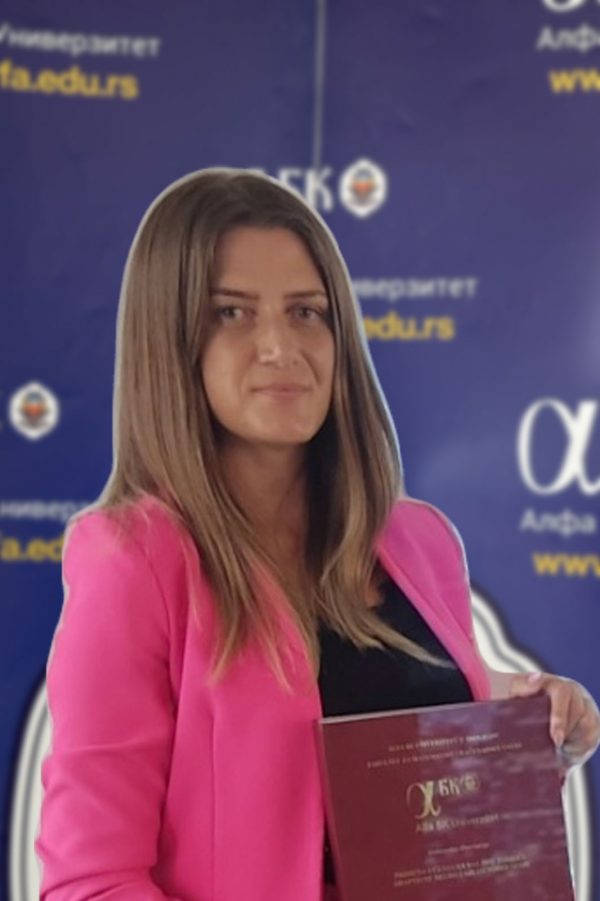
Jelena Stojanović
Docent • Repozitorijum radova
Biografske reference
Publikacije i radovi autora klasifikovani su po godinama i prikazani u kompaktnim karticama.
2025
JUSTIFICATION AND SPECIFICITY OF APPLICATION OF BUSINESS INTELLIGENCE
M33AlfaTech
JUSTIFICATION AND SPECIFICITY OF APPLICATION OF BUSINESS INTELLIGENCE
Denić, Nebojša; Stojanović, Kostadinka; Stojanović, Jelena
2025
1(1)
3042-3449
—
1–4
The subject of this work is studious expertise on possible aspects of the use of business intelligence in small and medium-sized enterprises in the Republic of Serbia, using the latest relevant professional literature and research content and conducting research in concrete business systems in Serbia. In the theoretical part of the work, the concepts of business intelligence, business intelligence systems, specifics of application in the Republic of Serbia, and the justification of business intelligence introduction projects will be explained. This work aims to answer the questions: what are the needs and analytical capabilities of small and medium-sized enterprises in Serbia, and what are the critical success factors for the efficient and effective deployment and use of business intelligence methods, techniques, and tools in enterprises in Serbia? For the work, an analysis of the application of one of the techniques of business intelligence - knowledge discovery in data in a specific company was done. In the final part of the work, the research results will be evolved, the results will be discussed and the conclusion based on them will be made.
business intelligence, IT projects, intelligent systems
M33
Innovations in Risk Management - Integration of Neural Networks in Boilers with Automatic Firing
—Complex System Research Centre, Niš, Serbia; Mathematical Institute of the Serbian Academy of Sciences and Arts, Serbia
Innovations in Risk Management - Integration of Neural Networks in Boilers with Automatic Firing
Popović, Stefan; Denić, Nebojša; Stojanović, Jelena; Đukić, Dejan; Popović, Đukić Sonja
2025
—
—
978-86-82602-04-0
—
Already at the beginning of the first quarter of the twenty-first century, we are witnessing the increasing application of artificial intelligence in all stages of life. The paper you are reading highlights the importance of implementing neural networks on boilers with automatic firing and is the result of a project that is entering its fifth year of experimental verification. The application of neural networks in boilers with automatic firing gives good results in risk management, through the prediction of system failures and their early software elimination. Artificial intelligence systems applied to boiler systems can reduce the harmful effects of the systems themselves, but also prevent accidents that can threaten people's health and safety, as well as cause material damage.
—
—
Robotization and artificial intelligence in the function of Industry 4.0
M33Proceedings of International Scientific and Professional Conference “ALFATECH“ Smart Cities and modern technologies
Robotization and artificial intelligence in the function of Industry 4.0
Denić, Nebojša; Gligorijević, Milan; Mihaljović, Saša; Stojanović, Jelena; Stojanović, Kostadinka
2025
—
—
9788664610933
67–72
—
This research paper will present how advances in robotics and artificial intelligence affect economic and social transformation. Based on the review of the latest literature and research conducted in practice, the relationship between artificial intelligence (AI) and robots will be evolved due to rapid technological development and the increasing application of methods, techniques and tools of artificial intelligence in various spheres of life and work. Starting with a clear definition and tracing the evolution of artificial intelligence in robotics, the paper will highlight its role, importance and application in various fields. Studies show that artificial intelligence and robotics offer great opportunities for improving life and work, improving efficiency and precision, reducing costs, errors, etc. In this context, this research study presents a critical assessment of the application of the phenomenon of artificial intelligence and robots, based on successive studies of relevant literature, evaluating artificial intelligence and robots, their development, characteristic forms and application in everyday life. Due to their capabilities, robots with elements of artificial intelligence have successfully replaced humans in performing many difficult and physically demanding and dangerous jobs, as well as in mentally simple and repetitive activities, which certainly justifies their humane application. Practice indicates that the process of implementing artificial intelligence and robots requires an adequate ICT infrastructure, followed by specialized training of key users, as well as compliance with all ethical rules of use. Research results indicate that robotics and artificial intelligence have become key players in the transformation of the world, opening the door to new ways of working and optimizing existing business processes. In this sense, the application of artificial intelligence and robots opens the door to new technological innovations and potential opportunities for the improvement of the product and service sectors. Considering the topicality of the topic, there are still insufficient studies dealing with the application of artificial intelligence (AI) in robotics by researching the integration, progress and implications of intelligent robotic systems based on artificial intelligence. Practice shows that in addition to all the benefits, one should be extremely careful and not ignore the criticism of experts in this field about the exponential development of robotics and artificial intelligence and the present fear that robots will one day become a threat to human society.
Digitization, Industry 4.0, Robots, Artificial Intelligence
M33
2024
The Impact of Digital Literacy and the Application of Educational Software on the Quality of Teaching
M3310th International Scientific Conference Technics, Informatic, and Education
The Impact of Digital Literacy and the Application of Educational Software on the Quality of Teaching
Denić, Nebojsa; Gavrilović, Snežana; Stojanovic, Jelena; Stojanović, Kostadinka; Milic, Momir
2024
—
—
9788677762766
34–34
In this paper, the possibilities of applying educational software and the influence of digital literacy in the function of electronic teaching are investigated. For the purposes of the work, the latest relevant literature in the country and abroad in this current field was researched. The subject of research of this paper will be a comparative analysis of educational software that is applied in our environment with a special emphasis on educational institutions in the area of Kosovo and Metohija and the Toplic district. Based on the conducted research, the paper will present an overview of the most popular software that is used today in the teaching process. The goal of the research is to determine teachers’ attitudes about the application of educational software in teaching, to investigate the effects and possibilities of improving teaching, highlighting the positive effects that can be achieved by their application in primary, secondary and high schools. The results of the research show that the use in subject teaching resulted in an increase in the quantity and quality of students’ knowledge compared to the traditional form of teaching, as well as that students generally have a positive attitude towards the use of educational software in teaching. Standard methods of statistical processing will be used for data processing.
Educational software; Digital literacy; Electronic education
M33
APPLICATION OF ARTIFICIAL INTELLIGENCE IN EDUCATION IN THE FUNCTION OF RAISING ENTREPRENEURIAL COMPETENCE
M33SCIENCE International Journal
APPLICATION OF ARTIFICIAL INTELLIGENCE IN EDUCATION IN THE FUNCTION OF RAISING ENTREPRENEURIAL COMPETENCE
Stojanović, Jelena; Stojanović, Kostadinka; Denić, Nebojša; Milić, Momir
2024
3(3)
2955-2044
—
149–152
—
—
—
M33
The Effects of Implementing Educational Software in Subject-Specific Mathematics Instruction
M3310th International Scientific Conference Technics, Informatic, and Education
The Effects of Implementing Educational Software in Subject-Specific Mathematics Instruction
Gavrilović, Snežana; Mojsilović, Marija; Denić, Nebojša; Stojanović, Jelena; Stojanović, Kostadinka
2024
—
—
9788677762766
570–575
In a modern educational context, educational software is becoming a key tool for enhancing mathematics teaching. Our study explores the effects of implementing such software on students’ achievements. The motivation for this research stems from the results of the PISA testing, which indicated below-average knowledge among our students. An analysis of factors influencing student achievements was conducted using the Adaptive Neuro-Fuzzy Inference System (ANFIS) method, confirming the importance of educational software in improving students’ mathematical skills. Subsequently, an experiment was conducted over three school years, involving two groups of students. The first, experimental group utilized educational software as the primary tool for learning mathematics, while the second, control group continued with traditional teaching methods. Through carefully designed experimental protocols, data on student achievements were collected via various mathematics knowledge tests, as well as their satisfaction with both traditional teaching methods and interaction with the software. The research results demonstrate that students using educational software achieve significantly better results on mathematics knowledge tests and are more satisfied with their learning compared to the group taught using traditional methods. This study highlights not only the positive impact of educational software on mathematics achievements but also the need for further research and practice in integrating technology into teaching to achieve optimal educational outcomes.
Educational software; Mathematics; PISA testing; ANFIS method
M33
Paradigms of application of business data analysis and business intelligence in public administration and local self-government
M33Proceedings of International Scientific and Professional Conference “ALFATECH“ Smart Cities and modern technologies (March 15th 2024, Belgrade, Serbia)
Paradigms of application of business data analysis and business intelligence in public administration and local self-government
Stojanović, Kostadinka; Denić, Nebojša; Stojanović, Jelena N.
2024
—
—
978-86-6461-074-2
286–289
https://plus.cobiss.net/cobiss/sr/sr/bib/148859401#izum.si
https://enauka.gov.rs/handle/123456789/927207
—
—
M33
Paradigms of Digital Competencies of Students in Higher Education in the Age of COVID-19
M3310th International Scientific Conference Technics, Informatic, and Education
Paradigms of Digital Competencies of Students in Higher Education in the Age of COVID-19
Bulut Bogdanović, Ivana; Denić, Nebojša; Stojanović, Jelena; Stojanović, Kostadinka; Milić, Momir
2024
—
—
9788677762766
462–469
This qualitative study aims to investigate the degree of digital competences of students at the university level and their readiness for the modern digital surrounding context. In this sense, the challenges in higher education that are a consequence of the pandemic, COVID 19 will be presented, focusing mainly on the increased use of ICT in the learning process among students. By reviewing the representative literature in the field of digital competences, the existing models and programs for the development of digital competences, i.e. the factors that influence their development, will be evolved. The aforementioned activities will be undertaken with the aim of proposing recommendations for the improvement of educational, i.e. curricula, as well as strategies for the development of digital competences in educational institutions, to investigate students' perceptions of their digital abilities and needs, as well as to propose recommendations for promotion. For the purposes of the work, research will be conducted through semi-structured interviews, where through cooperation with students and professors we will try to answer the research questions. The results of existing research confirm the hypotheses of this work that based on predictions, there may be significant differences in the level of digital competences among students of different study programs, as well as depending on the availability and use of technology in the educational process. In this direction, it is expected that this research will provide a deep insight into the level of digital competences of students, which will enable a better understanding of their needs and challenges in the modern educational context. We hope that the results of this work will serve as a basis for the development of effective strategies and programs for the improvement of students' digital competencies. The results of the analysis will also show to what extent the daily use of ICT has burdened students and teachers or made their work easier.
Educational software; Digital literacy; Electronic education; Digital competences; COVID 19
M33
Тransformation of e-administration into digital administration and smart cities and villages
M33Proceedings of International Scientific and Professional Conference “ALFATECH“ Smart Cities and modern technologies (March 15th 2024, Belgrade, Serbia)
Autori
Stojanović, Jelena N.; Denić, Nebojša; Stojanović, Kostadinka
2024
—
—
978-86-6461-074-2
—
290–295
https://plus.cobiss.net/cobiss/sr/sr/bib/148885769#izum.si
https://enauka.gov.rs/handle/123456789/927219
—
—
M33
2023
Интелигентни системи за подршку пословању
—Чачак : Универзитет у Крагујевцу, Факултет техничких наука
Интелигентни системи за подршку пословању
Нешић, Зоран; Денић, Небојша; Стојановић, Јелена Н
2023
—
—
978-86-7776-267-4
—
240
https://enauka.gov.rs/handle/123456789/782657
https://plus.cobiss.net/cobiss/sr/sr/bib/119988489#izum.si
—
—
—
Prediction of the Factors Affecting the Permanence of Knowledge in Mathematics Using Soft Computing
M33Proceedings (MDPI)
Prediction of the Factors Affecting the Permanence of Knowledge in Mathematics Using Soft Computing
Gavrilović, Snežana; Stojanović, Jelena; Denić, Nebojša
2023
—
2504-3900
—
34–34
In this scientific research work, the possibilities of applying artificial intelligence of neural networks, i.e., Adaptive Neuro-Fuzzy Inference System (ANFIS) methodology will be presented and explored as a support in teaching mathematics in predicting the durability of knowledge. The results of the research show that it is through the use of these sophisticated technologies that students’ achievements in mathematics can be improved, and that research in this direction is very much needed.
mathematics; student; scientific literacy; knowledge; ANFIS methodology
M33
2022
Adaptive neuro fuzzy selection of important factors for prediction of plasmons in silver nanorods
M22Applied Optics
Adaptive neuro fuzzy selection of important factors for prediction of plasmons in silver nanorods
Dragan M. Zlatkovic; Dalibor Petković; Mohamed Amine Khadimallah; Yan Cao; Nebojsa Denic; Vuk Vujovic; Jelena Stojanovic
2022
61(10)
1559-128X
—
—
2864–2864
The major goal of this study was to find predictors of plasmon positions in silver nanorod (NR) optical absorption spectra. The goal of this study is to use an adaptive neural fuzzy inference system to identify the various input parameters for longitudinal surface plasmon resonance (LSPR) and transverse surface plasmon resonance (TSP). A seed strategy has been used for preparation of the silver NRs. During the preparation, the seed particles are synthesized in the presence of cetyltrimethylammonium bromide (CTAB). To produce the silver NRs, metal salt (AgNO3) has been added, as well as ascorbic acid (AA) and CTAB. Skillful prediction could play a pivotal role in the plasmon NR production management. The combination of CTAB and the seeds has the largest influence on the TSPR. The combination of CTAB and AA has the largest influence on the LSPR. The study considering different input parameters simultaneously, to the best of our knowledge, is the first on a small scale and should attract great general interest.
—
M22
Appraisal of information and communications technologies on the teaching process by neuro fuzzy logic
M21Computer Applications in Engineering Education
Appraisal of information and communications technologies on the teaching process by neuro fuzzy logic
Yan Cao; Zenah M. AlKubaisy; Jelena Stojanović; Nebojša Denić; Dalibor Petković; Dragan M. Zlatkovic; Aleksandar Zakić
2022
30(3)
1061-3773
—
779–802
The use of modern information and communication technologies (ICTs) in the learning process has many advantages, but, as recent research has shown, their introduction into the teaching process is rather slow and complex. The rapid development of ICT has caused many changes in society and, consequently, in the education process. The integration of ICT into the teaching process transforms traditional teaching into new teaching that is ready to respond to the demands and needs of a contemporary learner to increase the quality of education: better student motivation, use of different sources of knowledge, development of functional abilities of students, and the ultimate goal is to increase learning outcomes. For that reason, this article explores the possibilities and ways of introducing GeoGebra's mathematical software in geometry classes and its impact on teaching and understanding of processed material by students. In this study, we analyze the influence of educational software in mathematics lectures. The main goal of educational software is to improve teaching performances and make mathematics attractive for the teaching and learning process as well. Educational software represents a combination of ICT and electronic learning (e-learning). Taking into account the specifics of the application of these technologies in different scientific disciplines, the aim of this article is to analyze the impact of the teachers' scientific field on the effects of the application of these technologies in selected higher education institutions. The research included teachers from 10 faculties and 3 schools of applied studies, who provided answers to 20 survey questions. A questionnaire study was applied to obtain training and testing data for statistical evaluation. The statistical analysis was based on an adaptive neuro-fuzzy inference system (ANFIS). The results confirm that the educational software in mathematics lectures is a very important factor for improvement of the teaching process. The effects of this software on motivation, interest, and confidence of the course's participants were observed. The use of ICTs through the use of GeoGebra will be a new challenge for both teachers and students. An assessment of the motivation and achievement of two groups of students was carried out. The control group and experimental group attended classes in a traditional way and by using ICT, respectively. The results of the research have highlighted the huge advantages of introducing ICT into the teaching process.
—
M21
Engine performance fueled with jojoba biodiesel and enzymatic saccharification on the yield of glucose of microbial lipids biodiesel
M21a+Energy
Engine performance fueled with jojoba biodiesel and enzymatic saccharification on the yield of glucose of microbial lipids biodiesel
Milovancevic, Milos; Zandi, Yousef; Rahimi, Abouzar; Denić, Nebojša; Vujović, Vuk; Zlatković, Dragan; Ilic, Ivana D.; Stojanović, Jelena; Gavrilović, Snežana; Khadimallah, Mohamed Amine; Ivanović, Vladan
2022
239
0360-5442
—
122390–122390
The study's major purpose was to find the best predictors for biodiesel efficiency based on emission variables and using jojoba oil as a fuel. Given the importance of biodiesel in reducing carbon dioxide emissions, a more thorough examination of such engines is required. As a result, the study's major goal was to use a selection technique to determine the best predictors for brake thermal efficiency (%), unburnt hydrocarbons (ppm vol.) and oxides of nitrogen (ppm vol.) of the biodiesel engine. For such a purpose several factors are selected and analyzed. The input variables are blending (%), fuel injection timing (obTDC), fuel injection pressure (bar) and engine load (%). The analyzing procedure was performed by adaptive neuro fuzzy inference system (ANFIS) and all available parameters are included. The ANFIS model could be used as simplification of the analysis since there is no need for knowledge of internal physical and chemical characteristics of the biodiesel engine. The results from the function clearly indicate that the input attribute “Engine load” (RMSE = 1.8002) is the most influential for the brake thermal efficiency. Furthermore, the input attribute “Fuel injection pressure” (RMSE = 4.2620) is the most influential for the unburnt hydrocarbons. “Engine load” (RMSE = 4.7484) is the most influential for the oxides of nitrogen. In this paper, an adaptive neuro fuzzy inference system (ANFIS) was used to develop a prediction approach for determining the influence of hydrolysis time, cellulase loading, b-Glucosidase loading, substrate loading and working volume on the enzymatic saccharification on the yield of glucose. The ideal combination of two input attributes or two predictors for enzymatic saccharification on glucose yield was discovered to be “substrate loading” and “working volume” (RMSE = 4.1625). The findings could be useful in reducing the cost of the procedure by optimizing enzymatic saccharification on glucose response yield.
—
M21a+
Optimization of a plastic optical fiber based sensor for dye sensing coupled with an adapted neuro-fuzzy inference system
M22Applied Optics
Optimization of a plastic optical fiber based sensor for dye sensing coupled with an adapted neuro-fuzzy inference system
Dragan M. Zlatkovic; Dalibor Petković; Nebojša Denić; Ivana D. Ilić; Sinisa Ilić; Nenad Kojić; Jelena Stojanović
2022
61(10)
1559-128X
—
2715–2715
In this study, estimation capacities and optimization of a dye concentration sensing model by an adapted neuro-fuzzy inference system (ANFIS) as well as central composite design coupled with response surface methodology using a plastic optical fiber (POF) based sensor were investigated. Various diameters of POF were used for sensing different concentrations of Remazol Black B (RBB), which acts as a sensing medium of the process. The efficiency of sensing was studied as a function of three independent variables: diameter of POF, concentration of RBB dye, and initial temperature of the solution. First, the independent parameters were fed as inputs to an ANFIS, and the output of the system was the output intensity of dye ratio to output the intensity of distilled water. ANFIS showed that this established model is reliable for a dye concentration sensing process and is mainly influenced by its diameter.
—
M22
Application of neuro-fuzzy estimation in prediction of shear bond strength between concrete layers through the efficient laser roughness analyzer
M21aOptics and Laser Technology
Application of neuro-fuzzy estimation in prediction of shear bond strength between concrete layers through the efficient laser roughness analyzer
Petković, Dalibor; Zeng, Jie; Denic, Nebojsa M; Stevanovic, Vesna; Marzouki, Riadh; El-Arab, Islam Ezz; Stevanovic, Malisa; Stojanovic, Jelena N; Khadimallah, Mohamed Amine
2022
151
0030-3992
—
108017–108017
To ensure the monolithic behavior of reinforced concrete composite parts, the bond strength at the interface between concrete layers cast at various ages must be high. Reinforced concrete composite members include precast beams with cast-in-place slabs, bridge decks strengthened by adding a new concrete layer, and repair and strengthening of existing concrete structural members by adding a new concrete layer. In this study, the shear bond strength (SBS) of reinforcing steel on Portland cement and a hybrid cement including slag and Portland cement activated with sodium carbonate is investigated. The pull-out test was used to determine SBS; also a subsequent test data is evaluated using ANFIS, as well as surface classification utilizing a laser roughness analyzer designed particularly to assess the roughness of the concrete substrate. As a result, this research tried to create an in situ non-destructive approach for assessment of concrete surfaces and its influence on shear bond strength measurement of the concrete layers. All test data is analyzed using an adaptive neural fuzzy inference system (ANFIS) to classify the different input variables for determining the shear bond strength between concrete layers using the mean and maximum surface roughness (SR) height parameters Ra and Rt in X and Y direction. ANFIS was used to optimize the process based on five processing parameters. Skillful prediction could play a pivotal role in the optimal conditions during laser cutting process. Based on results, laser speed is the most influential on the Ra in X and Y direction (RMSE: 0.3255, RMSE: 0.6869, respectively). The most influential parameter on the Rt in X direction is laser power (RMSE: 1.5611), while the most influential parameter on the Rt in Y direction is laser speed (RMSE: 2.0781), resulting that the roughness of the substrate surface highly affects the shear bond strength of concrete interfaces.
—
M21a